Why Nearby Scenery Looks Faster from a Train Window
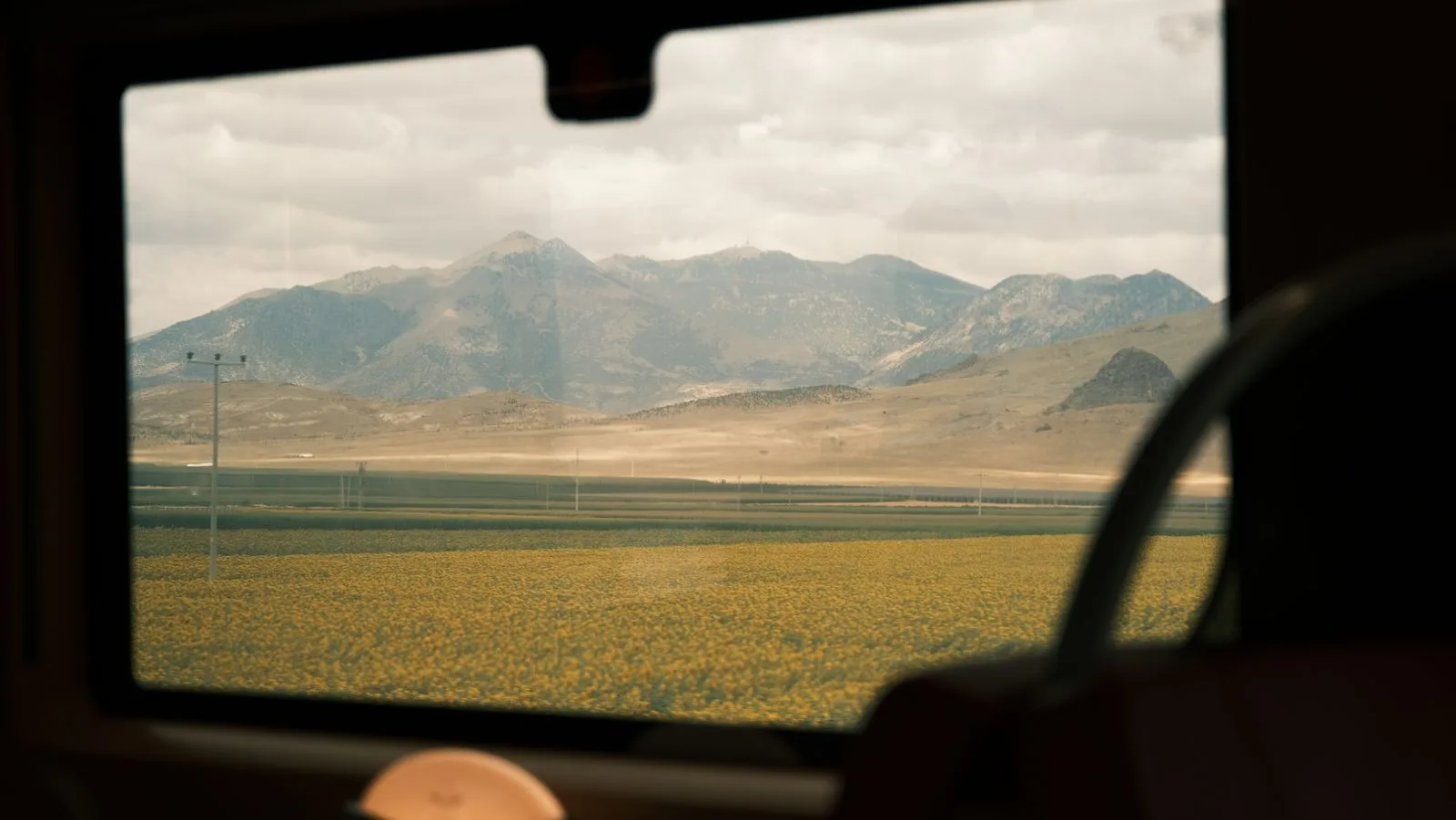
Rahime Gül · Pexels · Pexels License
From a train window, a nearby fence can flick past too quickly to follow while a mountain seems to travel alongside you. The train does not need to change speed for these two impressions to happen together. Distance changes how quickly a landmark's direction shifts across your view.
That makes an ordinary rail journey a useful way to notice motion parallax: the different apparent movement of scenery at different distances as you move.
One journey, several layers of movement
Imagine a straight stretch of track with stationary fence posts, a village beyond them and hills on the horizon. All three remain fixed to the ground. As your seat moves, however, the direction from your eyes to each feature changes by a different amount.
A close post can cross much of the window in a moment. A distant hill changes direction more slowly. Your view contains several layers of apparent movement, although the train has one ground speed.
NASA's introduction to parallax explains the underlying geometry: an object's apparent position against a distant background changes when the observer changes position. On a train, that change of viewpoint happens continuously.
A small calculation explains the difference
Angular speed describes how quickly an angle changes; OpenStax introduces this quantity. We can apply that definition to a deliberately simple train-window model.
Assume the train travels in a straight line at 72 km/h, or 20 m/s. At the instant you are directly beside a stationary landmark, its apparent angular speed is:
ω = v ÷ d
Here, v is the train's speed and d is the landmark's perpendicular distance from your path. With meters and seconds, the result is in radians per second.
| Distance d | Calculation | Angular speed |
|---|---|---|
| 20 m | 20 ÷ 20 | 1 rad/s |
| 200 m | 20 ÷ 200 | 0.1 rad/s |
| 2000 m | 20 ÷ 2000 | 0.01 rad/s |
In this example, increasing the distance tenfold reduces the angular speed to one tenth. These are calculated illustrations, not measurements from a particular train or SpeedX test.
The formula describes that directly-beside instant. As a landmark approaches or falls behind, its viewing geometry changes. Curves, turning your head and objects that themselves move also change what you see; do not apply the table to every view out of a window.
Why a train can feel faster near a station
Compare an open landscape with a section lined by nearby walls and posts. Even at the same train speed, close features can sweep across your view much faster. A change in the passing scenery therefore does not, by itself, establish that the train accelerated or braked.
The same limitation applies to a short travel video: without knowing the scene's distances and viewing geometry, apparent movement does not supply a reliable ground-speed measurement.
Try watching the layers
From your seat, look through a closed window toward a stretch with both foreground features and distant terrain. Keep your head roughly still for a few seconds, then compare how far a nearby feature and the distant background shift. Repeat in more open country. The aim is to notice depth, rather than calculate a speed from the view.
If you want a separate speed reading, the online speedometer can display speed supplied by your browser when available. That depends on the device and positioning conditions. A missing reading inside a carriage or tunnel is a separate issue, explained in why GPS speed fails in tunnels and indoors.
Related Articles

2026-07-15
Understanding Altitude Zones: How Elevation Changes Everything
From sea level to the death zone — how different altitude ranges affect your body, your performance, and your safety in the mountains.

2025-12-28
The high-speed train hit 300 km/h
Experience high-speed travel like never before with SpeedX, the ultimate speed tracking app. Monitor real-time speeds with precision and reliability, whether on a train, car, or plane.

2025-07-03
Experience High-Speed Rail Travel with SpeedX App
Discover how SpeedX app enhances your high-speed rail journey by tracking train speeds, monitoring elevation changes, and recording your entire trip for a more engaging travel experience.